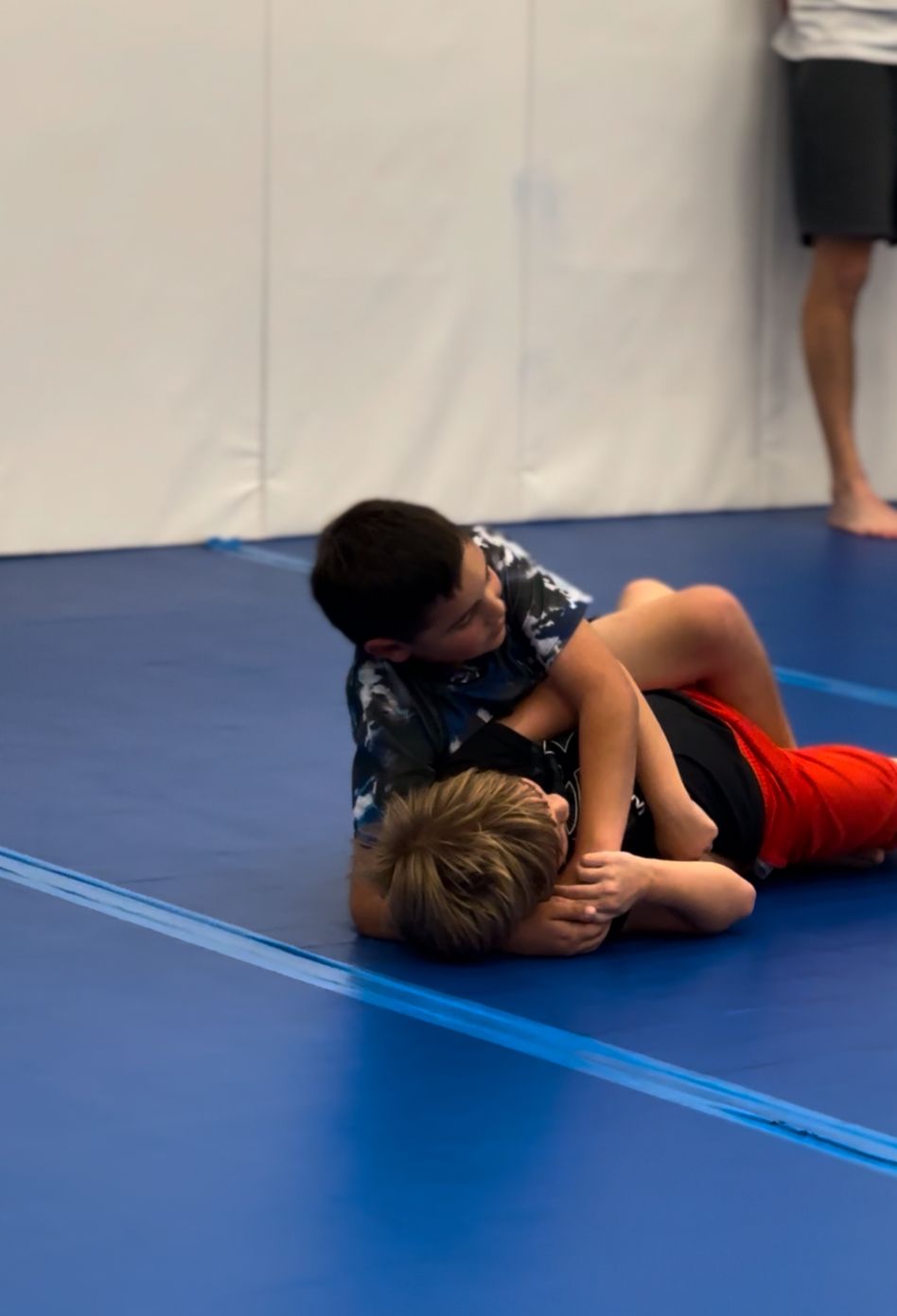
Grappling gives kids a place to struggle safely, solve problems fast, and walk out a little steadier than when they walked in.
If you’re a parent in Vacaville, you’ve probably noticed something: kids don’t just need exercise, they need an outlet that teaches composure. Our Grappling classes are built around that idea. We want your child to move better, think clearer under pressure, and learn what to do when something feels hard instead of quitting.
In our youth program, we blend submission grappling, no-gi Brazilian Jiu-Jitsu, and beginner wrestling into one structured, age-appropriate experience. The goal is not to make kids “tough” in a reckless way. It’s to make them resilient in a calm, practical way, with coaching that keeps training safe, supportive, and energetic.
And yes, the physical benefits are real, but the deeper win is what happens between the ears: learning to breathe, reset, and try again.
What Grappling Means Here (And Why It Works for Youth)
When people hear Grappling, the definition can get fuzzy. In simple terms, grappling is the skill of controlling another person without strikes using posture, grips, positioning, balance, and leverage. That includes takedowns, clinch work, pins, escapes, and submissions, all practiced with rules and supervision.
No-gi Brazilian Jiu-Jitsu, submission grappling, and beginner wrestling
Our youth classes draw from three closely related lanes:
• No-gi Brazilian Jiu-Jitsu teaches positional control and submissions without relying on a uniform for grips.
• Submission grappling blends control and submissions in a straightforward, athletic format.
• Beginner wrestling builds the base: stance, level changes, takedown safety, and the ability to keep balance when someone pushes back.
Together, this mix makes Grappling feel both practical and engaging, especially for kids who like movement and problem-solving more than standing in lines.
Why it’s different from striking sports
Many parents appreciate that grappling-based training develops self-control without focusing on punching or kicking. Kids still learn how to handle pressure and contact, but the emphasis stays on control, positioning, and responsible decision-making. In other words, we practice how to manage intensity, not how to escalate it.
How Youth Grappling Builds Real Resilience (Not Just “Confidence”)
Resilience is one of those words adults use a lot, but kids experience it in smaller moments. Grappling creates those moments on purpose, then gives your child tools to get through them.
Learning to be uncomfortable without panicking
In class, kids end up in positions that feel challenging: stuck underneath, held in place, or off-balance. Our job is to teach them what to do next. That can be as simple as framing correctly, turning to a safer angle, or taking a breath before making a decision.
The lesson becomes physical: pressure is information, not an emergency. That mindset carries over into sports, school stress, and social situations.
Progress through feedback, not perfection
Grappling is honest. If a technique is off by an inch, it usually doesn’t work. That can be frustrating at first, but it’s also what makes improvement measurable. We coach kids to treat mistakes like data, then adjust. Over time, the emotional reaction to “I messed up” shrinks, and the response becomes “OK, try again.”
Controlled challenge, repeated often
Resilience builds when challenge is consistent and safe. A good training environment pushes kids enough to grow, but not so much that they feel overwhelmed. That balance is a big part of our class structure: drilling for skill, games for athleticism, and supervised live training for real application.
Safety First: What Parents Should Know Before the First Class
“Is grappling safe for kids?” is one of the most reasonable questions you can ask. Any physical activity has risk, but Grappling can be trained in a way that is extremely mindful: clear rules, close coaching, and age-appropriate intensity.
What we do to keep training safe
We manage safety through coaching habits and class design, not just by saying “be careful.” A few standards matter a lot:
• We teach breakfalls and body awareness early so kids learn how to land and move safely.
• We match training partners with size, age, and experience in mind.
• We emphasize tapping early and often, and we treat tapping as smart, not weak.
• We keep live rounds structured and supervised so intensity stays appropriate.
• We teach control before we teach speed, because control is what prevents injuries.
Parents often feel relieved once they see how organized the room is. It’s active, but it’s not chaotic.
What “tapping” teaches beyond safety
Tapping is a safety tool, but it’s also a life lesson: recognizing limits, communicating clearly, and resetting without embarrassment. Kids learn that stopping is part of training, not a failure. That’s a surprisingly powerful confidence-builder.
Athletic Development That Helps in Every Sport (And Daily Life)
Even if your child never competes, grappling training can improve how they move and how they carry themselves. We see kids develop coordination and strength in a way that looks different than typical gym workouts.
Strength, coordination, and mobility
Grappling uses the whole body: pushing, pulling, bridging, posting, rotating, and stabilizing. That builds real-world athleticism: core strength, hip mobility, balance, and grip endurance. Kids also learn how to control their body weight, which helps with everything from running to climbing to just being less clumsy in the kitchen. It happens.
Spatial awareness and reaction time
Because Grappling is interactive, kids must constantly read distance and angles. That improves timing and decision-making. It’s one thing to run fast in a straight line. It’s another to adapt when a partner changes levels, shifts weight, or attempts a sweep. Those micro-adjustments develop athletic intelligence.
A calmer relationship with competition
Some kids thrive on competition, and some kids tense up the moment something is “on the line.” Grappling gives both types a place to learn healthy pressure. We teach kids to focus on effort and technique rather than outcomes, which is a skill that helps whether your child plays soccer, wrestles, dances, or just wants to feel more confident in PE.
What Your Child Learns in Our Youth Program
Our Youth Grappling Classes Vacaville are designed to give kids and teens a clear path from beginner basics to confident, capable movement. We don’t throw new students into the deep end. We build the foundation in layers.
Here are a few skills your child can expect to develop over time:
• Base and balance: how to stay grounded when pushed or pulled, and how to regain stance after losing it
• Escapes and reversals: how to get out from underneath and turn bad positions into neutral ones
• Positional control: how to hold stable positions using leverage instead of squeezing as hard as possible
• Takedown awareness: how to change levels, move safely, and understand where falls happen
• Submission basics: how to apply techniques with control, and how to recognize when to tap and reset
• Training habits: listening, taking turns, staying focused, and being a good partner even when tired
That last one matters more than people expect. A room full of kids can be loud, sure, but it can also be respectful and purposeful when the culture is right.
A Simple Path for Beginners: What the First Month Often Looks Like
Parents sometimes ask how quickly kids “get it.” The truth is, everyone learns at a slightly different pace. Still, the first month tends to follow a pattern if your child shows up consistently and stays open to coaching.
1. Week 1: Learning the room and the rules, basic movement, and how to partner safely
2. Week 2: Building simple escapes and positions, starting to recognize patterns
3. Week 3: Connecting techniques together, like escape to control, or takedown to position
4. Week 4: More confident live training with guidance, better pacing, and fewer panic reactions
5. Ongoing: Sharper technique, more composure, and a noticeable jump in body control
The biggest change many parents notice is not a specific move. It’s posture, eye contact, and the way kids handle being corrected. That’s the resilient-athlete part showing up.
What to Wear and Bring (So You Don’t Overthink It)
You don’t need a complicated setup for Grappling. For no-gi training, athletic clothing that allows movement is usually enough. We recommend a fitted rash guard or athletic shirt and shorts or leggings without pockets or zippers, since those can scratch or snag.
Bring water, show up a little early, and plan to ask questions. If you’re not sure what your child should wear for the first day, we can point you in the right direction when you contact us or check the program details on the website.
Training Frequency: How Often Kids Should Practice to See Progress
Consistency beats intensity, especially for young athletes. For many families, two classes per week is a strong starting point. It’s enough repetition to build skill, but not so much that kids feel burned out.
If your child loves it and wants more, adding a third day can accelerate progress. If your schedule is tight, even once a week can be a meaningful introduction, but you’ll usually see slower momentum. The key is keeping training steady and letting the skills layer over time.
Adult Grappling in Vacaville: A Strong Option for Parents, Too
A lot of parents come in for the kids and then realize something quietly important: training looks like fun. Adult Grappling in Vacaville gives you a chance to build strength, flexibility, and stress resilience in the same problem-solving way kids do, just scaled for adult bodies and goals.
Adult training can also make you more fluent in what your child is learning. You’ll understand why position matters, what “control first” means, and why a tough round can be a good day, even when you feel a little tired on the drive home.
Take the Next Step
Building resilient young athletes is not about pushing kids into intensity before they’re ready. It’s about giving them structured challenge, strong coaching, and a team environment that makes progress feel possible week after week. That’s exactly what we aim for in every class, whether your child is brand new or ready for the next level.
If you’re looking for Youth Grappling Classes Vacaville that develop confidence with real skills behind it, our coaches are ready to help you get started at Vacaville Grappling Academy, with a welcoming process and a clear path forward.
Turn these techniques into real-world skills by enrolling in a grappling program at Vacaville Grappling Academy.