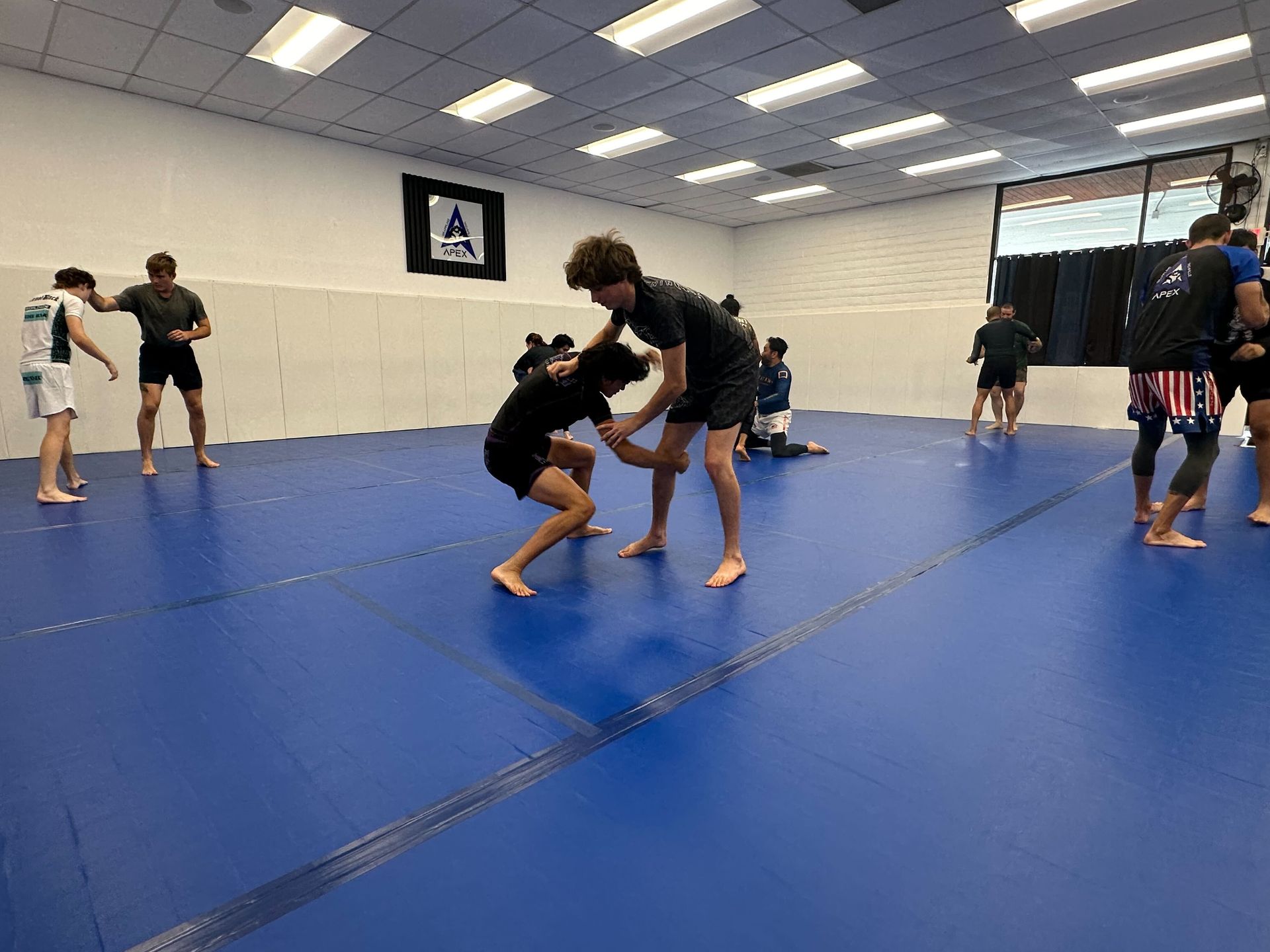
Grappling gives you the kind of full-body strength, conditioning, and control that shows up in every sport once the game gets messy.
Athletes in Vacaville train hard, and most already have a routine that covers the basics: strength work, sport practice, maybe some running or mobility. The challenge is finding cross-training that actually carries over when you are tired, off-balance, or forced to adapt in real time. That is where grappling stands out.
In our classes, you are not just “getting a workout.” You are building usable athletic qualities: bracing under pressure, moving another human safely, and staying calm when your lungs are burning. Those skills translate whether you play field sports, run, lift, compete, or just want to feel more capable in your body.
One reason we like grappling for athletes is that it develops performance without requiring you to be a specialist in it. You can train consistently, improve quickly, and bring those gains back to your primary sport without feeling like you have to “switch identities” to do it.
What makes grappling such effective cross-training
Most cross-training improves one or two qualities at a time. Grappling stacks several adaptations into the same session: strength endurance, coordination, core stability, mobility, and decision-making under fatigue. It is a rare combination, and it is the reason so many athletes feel the carryover fast.
Research on grappling athletes shows measurable performance differences versus untrained individuals, including about 34 percent greater work capacity and 56 percent greater tolerance to severe-intensity exercise, while max grip strength can remain similar. In other words, you can do more work, for longer, at higher intensity, without needing to chase “bigger numbers” all the time. For an athlete, that is gold.
We also love the honest feedback loop. If a position is unstable, you know immediately. If your posture breaks, you feel it. That kind of instant reality check builds better movement patterns than a lot of isolated drills.
The athletic qualities you build on the mat
Work capacity that actually transfers
A hard round feels a lot like sport: bursts of effort, brief resets, then more effort. You learn to recover while moving, not only while resting. Over time, that changes how your body handles intensity. When you go back to your main sport, the pace often feels more manageable because your system is used to repeated surges.
Strength endurance and “real” core stability
In grappling, your core is not just a set of muscles you train. It is how you connect your hips to your shoulders while someone tries to fold you up, turn you, or pin you. You learn to brace, rotate, and breathe under pressure. That matters for sprinting mechanics, throwing, cutting, and contact.
Agility, coordination, and balance under chaos
Footwork ladders are fine, but they do not fight back. On the mat, balance is a living thing. You are constantly adjusting base, changing levels, and recovering from compromised positions. Those reactions help athletes who need to stay upright, stay explosive, and stay coordinated when a play breaks down.
Mobility with a purpose
We see athletes who already stretch, but still move “tight” in certain patterns. Grappling puts you in positions that challenge hips, ankles, thoracic rotation, and shoulder stability in a practical way. You are not chasing flexibility for its own sake. You are building range of motion you can control, which is the part that tends to keep you safer.
Why cross-training matters for injury prevention and longevity
Sport specialization can be rough on the body, especially when you repeat the same patterns year-round. Research has also highlighted higher injury risk and even higher surgical intervention rates in athletes who specialize too early or too exclusively. A simple shift, like adding a second sport for a few months, can help reduce that risk. We think of it like rotating the tires on your car: the goal is better performance now and a longer “training life” overall.
Grappling fits that idea well because it gives you new movement problems to solve. You rotate stress across joints and tissues in a different way than your main sport does, while still training hard. You also build body awareness, which is underrated. Knowing where your hips are, where your weight is, and how to fall or post safely can save you from awkward tweaks on the field, in the weight room, or even stepping off a curb when you are tired.
We coach with control and progressive intensity so you can train consistently. Consistency is what actually protects you over time, not occasional heroic workouts.
How our adult classes support athletic goals in the real world
A lot of adult athletes in Vacaville are balancing training with work, family, and recovery. Our approach is built for that reality. You can come in, train hard, learn something useful, and leave feeling like you got better, not like you got run into the ground.
A typical class flow (and why it works)
We keep classes structured because athletes do best when intensity is planned, not random. While each day has a focus, the rhythm is familiar enough that you can measure progress week to week.
Most sessions include:
- A targeted warm-up that builds joint readiness, coordination, and specific movement patterns we will use
- Technique practice focused on strong positions, safe mechanics, and details that matter under pressure
- Positional training where you repeat a scenario with a clear goal so you can improve quickly
- Live rounds scaled to your experience and your current training load
- A short cool-down and quick guidance on what to drill next time
That structure is one reason grappling in Vacaville works so well for adults who want cross-training without chaos. You get intensity, but it is guided.
Scaling intensity for in-season and off-season athletes
If you are in-season, we help you keep training without piling on fatigue in the wrong places. That might mean more positional rounds, slightly shorter live exchanges, or focusing on efficient movement rather than grindy battles.
If you are off-season, we can push conditioning and volume more. You can build that deeper gas tank and strength endurance that shows up late in games, late in meets, and late in training blocks when everyone else fades.
Sport-to-mat carryover: what athletes notice first
Athletes usually feel the benefits in a few specific ways, and it tends to happen faster than expected.
Better scrambling and recovery
Scrambling is not only for combat sports. It is the ability to regain position after losing it. In grappling, you train that constantly: hips moving, base rebuilding, balance returning. Athletes often report that they recover faster from awkward contact, slips, or sudden changes of direction.
Positional awareness and leverage
Leverage is the language of efficient movement. When you learn how weight distribution works in clinches, pins, and transitions, you start noticing leverage everywhere: in how you plant your foot, how you turn your hips, how you absorb force. That awareness can improve efficiency without adding extra strength training.
Mental toughness without the “motivational speech” vibe
We are not interested in hype. But grappling naturally builds resilience because you get put in uncomfortable positions and learn to solve them. You breathe, you problem-solve, you keep moving. That calm focus carries over to competition settings when emotions spike and mistakes happen.
Common concerns from adult athletes (and how we handle them)
“I do not want to get hurt.”
That is reasonable. We emphasize controlled training, smart partner selection, and clear rules around intensity. You will learn to tap early, communicate, and progress in a way that respects your body. The goal is sustainable training, not proving a point on a random Tuesday night.
“I am already strong and conditioned. Will this still help?”
Yes, because grappling is not just strength or cardio. It is strength plus timing, posture, breathing, and decision-making while you are fatigued. Even very fit athletes find the learning curve valuable because it exposes gaps that traditional training can hide.
“I am new, and I do not want to slow the class down.”
Our coaching is set up for mixed experience levels. You will have a clear role, clear reps, and partners who understand the goal is development. Beginners are not an inconvenience. They are part of a healthy room.
How to start cross-training with grappling without wrecking your schedule
If you want results and you want to stay fresh, start simple. Two sessions per week is enough for most athletes to see real carryover without compromising their primary training.
Here is a practical ramp-up we recommend:
1. Weeks 1 and 2: Train once or twice per week and focus on learning positions, breathing, and safe movement
2. Weeks 3 and 4: Add a second weekly class if recovery is good, and begin more live positional rounds
3. Weeks 5 and 6: Maintain two classes per week, track sleep and soreness, and adjust intensity based on your sport season
4. Ongoing: Keep grappling consistent, and treat it like skill training, not only conditioning
This keeps adult grappling in Vacaville realistic. You train hard, but you still show up strong for your main sport, your work, and everything else you have going on.
Take the Next Step
If you are looking for cross-training that builds conditioning, coordination, and confidence under pressure, grappling is hard to beat, and we have built our coaching and class structure to make it workable for real adult schedules. When you train with us, you get a plan, a clear progression, and a room that takes safety and improvement seriously.
At Vacaville Grappling Academy, we focus on helping athletes use grappling as a practical tool, not a distraction from the sports and goals that matter most to you, and you can see how our approach fits by checking the program details and the class schedule on the website.
Turn what you learned here into hands-on training by joining a grappling class at Vacaville Grappling Academy.