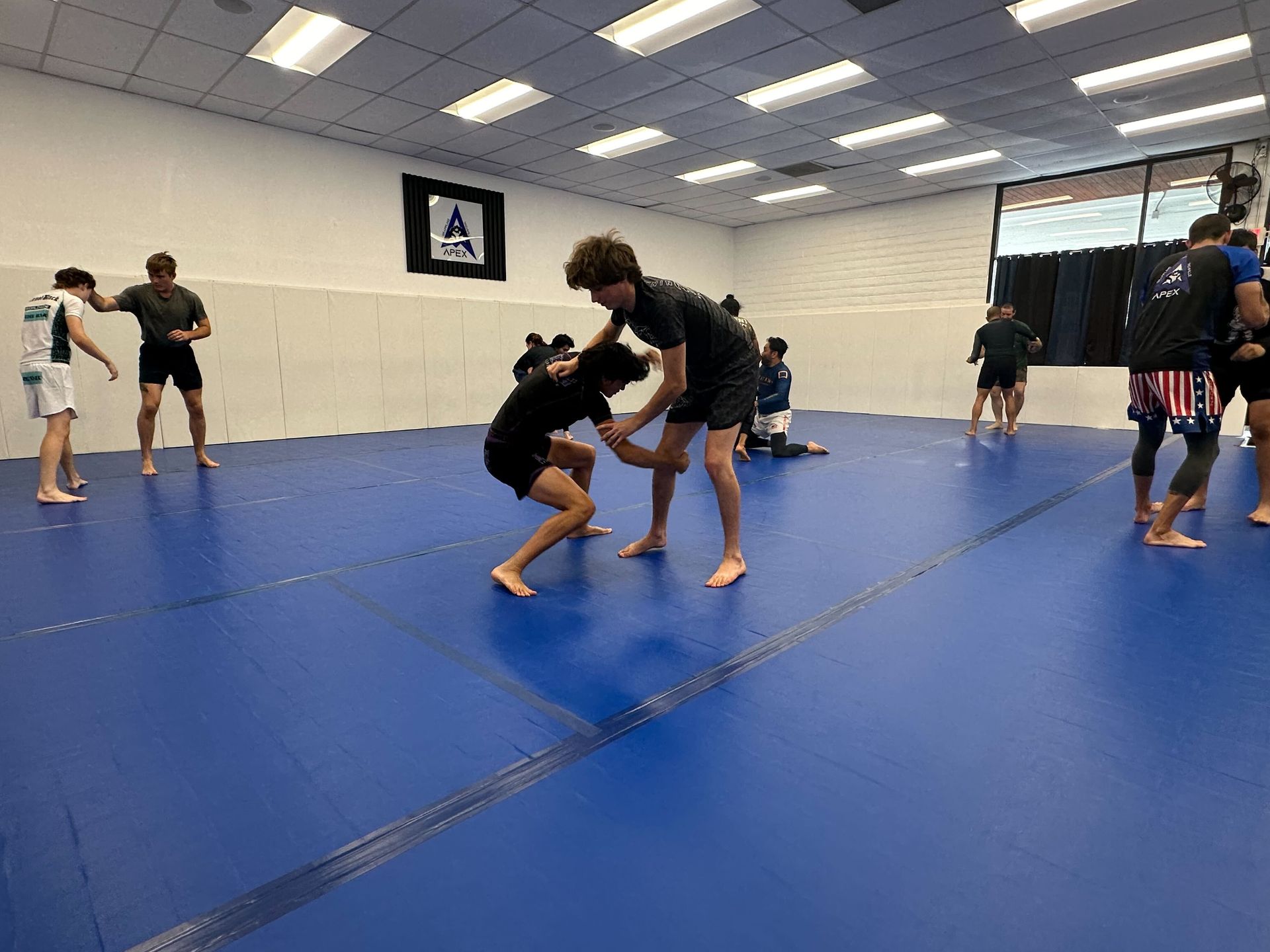
Real confidence is earned in small moments on the mat, and focus shows up when your child learns to solve problems under pressure.
If you are looking for a youth grappling program that does more than tire kids out, you are in the right place. In our classes, we use grappling martial arts like Brazilian Jiu-Jitsu and wrestling-inspired movement to help kids build confidence through real skill development, not hype. The best part is that progress is visible: a cleaner technique, a calmer reaction, a better choice in a tough moment.
Parents in Vacaville often tell us they want two things that feel hard to teach: focus and follow-through. We get it. School demands attention, friendships require emotional control, and screens compete for every spare second. Our approach to youth grappling in Vacaville is to make focus a habit by training it, the same way we train posture, balance, and timing.
Grappling is also having a major moment nationally, especially in wrestling. High school participation recently hit record highs, including big growth for girls, which tracks with what we see locally: more families want structured, confidence-building activities that feel practical and empowering. Our job is to make that growth meaningful for your child, one class at a time.
Why grappling martial arts build confidence differently
Confidence in kids is rarely about being loud or fearless. Most of the time, it is about feeling capable. Grappling martial arts reward capability because your child learns how to move, how to control balance, and how to solve a problem without relying on size or strength.
In class, we teach skills in manageable pieces, then we help students connect those pieces. When a child hits a technique for the first time, it is a real win. When that same child hits it again a week later with better timing, it becomes ownership. That is where confidence starts to look less like a mood and more like a steady trait.
We also keep expectations clear. Kids do well when the target is obvious: try, listen, practice, improve. When the goal is not to be perfect, but to be consistent, kids feel safer taking healthy risks. That is important for shy kids, for energetic kids, and for the kid who is still figuring out where we fit in.
Skill mastery creates durable self-belief
A lot of activities hand out praise, but grappling gives proof. Your child learns a grip, a base, a safe fall, or a simple escape, and then experiences it working with a partner. That moment is powerful because it is earned.
Over time, that proof stacks up. A child who used to freeze when challenged starts to engage. A child who avoided eye contact starts to ask questions. You might notice it at home in subtle ways: more willingness to try homework without a meltdown, more patience with a younger sibling, fewer big reactions when something feels unfair.
Safe challenge teaches resilience
Grappling includes controlled resistance, which sounds intense until you see it done correctly. We keep it structured and age-appropriate, and we coach students to treat partners with care. The resistance is what makes the lesson stick. Kids learn, sometimes in the span of a single round, that effort matters and calm matters.
That is resilience. It is not bravado. It is the ability to stay engaged when something is hard.
How a youth grappling program builds focus that carries into school
Focus is not just sitting still. Focus is staying present long enough to notice what is happening, choose a response, and adjust when it does not work. Grappling trains that naturally because every drill has feedback built in. If your base is off, you tip. If your timing is late, the opening disappears. Kids learn to pay attention because paying attention helps.
Live training, done responsibly, also encourages mindfulness. Students cannot daydream through a round. They have to breathe, think, and solve. Over time, kids start recognizing the difference between panic and pressure. That alone can be a game-changer for school stress and test anxiety.
Decision-making under pressure, without the panic spiral
One reason youth grappling in Vacaville works so well for focus is that the environment is real but controlled. Your child feels pressure, then learns to respond in a coached way. We cue simple problem-solving: posture first, then frames, then movement. That sequence helps kids avoid the all-at-once feeling that leads to quitting.
We also build routines that kids can rely on. Warm-up patterns, positional goals, and end-of-class reflections create structure. Structure is not boring for kids, it is stabilizing.
Physical development benefits you can actually measure
The confidence and focus gains tend to get the headlines, but the physical side matters too. Research on martial arts participation in kids ages 4 to 13 shows improvements in cardiorespiratory fitness, strength, flexibility, balance, and muscular endurance compared to non-athletes. Combat sports participants also tend to score higher on locomotor and manipulative skills, with meaningful effect sizes in studies.
In plain terms: kids get more coordinated. They learn how to move their bodies on purpose.
Because grappling is mostly ground-based, it develops full-body control and core strength in a way that feels like play, especially for younger students. The constant changes in position build athletic intelligence: how to turn, how to base, how to bridge, how to stand safely. Those skills support performance in other sports too, but more importantly, they support injury prevention and body confidence.
Why this matters for growing bodies
Kids who feel awkward often stop trying physical activities. That can snowball. When kids learn controlled movement in class, many start feeling more comfortable in their own skin. You might notice better posture, more willingness to run and climb, or less frustration when learning new movements.
We also keep an eye on recovery and age-appropriate training volume. For most families, two to three sessions a week is enough to see steady progress without overload.
What confidence looks like in real life for kids and teens
Confidence is not just about standing up to a bully, though that is a concern many parents quietly carry. Confidence is also speaking up in class, trying out for a team, or handling a mistake without falling apart.
In our youth grappling program, we set up small milestones that are realistic. Sometimes it is as simple as showing up consistently for a month. Sometimes it is learning to partner up with someone new. Sometimes it is staying composed when a round is not going your way.
A few examples of the kinds of shifts families commonly notice:
• Your child starts making eye contact and speaking clearly when greeting coaches and teammates
• Your child becomes more comfortable being corrected, because correction is normal on the mat
• Your child learns to lose without spiraling, then comes back to try again
• Your child starts setting goals, like improving a guard pass or earning the next stripe or belt
Those are confidence behaviors, and they tend to spill into school and home life in a way that feels quietly steady.
How we structure classes to support focus, discipline, and fun
Kids need fun, but fun works best with boundaries. We build our classes around clear rules, positive coaching, and a rhythm students can learn. That rhythm helps kids settle in quickly, even if their day at school was chaotic.
We also group students in a way that supports learning. Age and experience matter, but so does temperament. Some kids need more reassurance. Some need more challenge. Our coaches pay attention to both.
Here is what you can expect in a typical youth grappling class:
• A warm-up that builds coordination and basic movement patterns used in grappling
• Technique instruction with step-by-step cues and partner practice
• Drills that reinforce timing, balance, and decision-making
• Controlled live rounds or positional training, with safety rules reinforced
• A short wrap-up that highlights effort, improvement, and a clear next goal
This structure is one reason the focus gains show up. Kids learn to transition between playful energy and serious attention, which is a life skill on its own.
Promotions and milestones that reinforce healthy confidence
Belts and stripes matter to kids because they represent effort. We use promotions as a way to reward consistency, technical growth, and good training habits. When your child earns a stripe, it is not random. It is a signal that our coaches see progress in real, coachable areas like posture, partner safety, and technique retention.
That said, we are careful about making promotions the only motivation. The deeper goal is building internal confidence: the sense that your child can work at something, struggle a bit, and come out better.
This is where parents often notice a change in mindset. A child who used to say, “I cannot,” starts saying, “I cannot yet.” That is not cheesy. It is practical. It is the difference between quitting and learning.
Safety, supervision, and what parents should know about injuries
It is fair to ask whether grappling is safe. Any sport has risk, and grappling is no exception. The good news is that with qualified coaching, controlled intensity, and a culture of respect, the benefits tend to outweigh the risks. Most issues in youth training are minor, like bumps and bruises, and serious injuries are more likely in high-intensity competition settings than in well-run classes.
We keep safety simple and consistent: tap early, protect training partners, follow coach instructions, and train at the appropriate intensity for your age and experience. We also teach kids how to fall and how to move responsibly, which can reduce injury risk in everyday play and other sports.
If your child has any prior injuries or specific concerns, we encourage you to tell us upfront so we can make smart adjustments.
How to start, and what the time commitment looks like
Starting a youth grappling program should feel welcoming, not intimidating. Beginners belong in class from day one because we teach fundamentals in a way that meets students where we are. Your child does not need to be athletic, confident, or experienced to begin. We build those qualities through training.
A realistic schedule for most families is two to three classes per week. That pace gives enough repetition to improve while leaving room for school, rest, and family time.
If you are wondering how quickly you will see results, here is a general timeline we see often:
1. Weeks one to two: your child learns the rules, basic movements, and class rhythm, and starts feeling comfortable on the mat
2. Weeks three to six: technique starts to stick, and you will notice better composure and attention during drills
3. Months two to four: confidence becomes more consistent, and focus improvements show up in school habits and emotional control
4. Ongoing: skills deepen, goals become clearer, and your child starts mentoring newer students in small ways
Progress is not perfectly linear, especially for kids, but consistency is powerful.
Why grappling is especially effective for today’s kids in Vacaville
Kids are dealing with a lot right now: academic pressure, social stress, and the weird intensity of always being connected. Grappling gives them a place where the feedback is real and immediate, and where effort matters more than image. That alone can be a relief.
In Vacaville, we also see families looking for structured activities that build discipline without being harsh. Our mats are a place where kids can work hard, laugh a little, and learn how to handle challenge with control. That combination is what makes the confidence and focus gains last.
Take the Next Step
If you want your child to grow into calmer confidence and better day-to-day focus, our coaches can help you make that path practical and sustainable. At Vacaville Grappling Academy, we built our youth training around steady skill milestones, respectful partner work, and the kind of structure kids actually respond to.
When you are ready, we will help you choose the right class level and pace so your child can start strong, stay safe, and keep enjoying the process. Vacaville Grappling Academy is here to make your child’s progress feel real, not rushed.
To take your first class with us, sign up for a free trial.